

How Rice Husk Ash Properties Protect Molten Steel?
A steel plant can spend enormous energy getting molten steel to the right temperature, around 1,500°C and 1,650°C. Then, almost immediately, the plant has another problem to manage. What’s that? That loss cannot be eliminated. It can, however, be controlled using the rice husk ash properties. Properly processed Rice Husk Ash (RHA) can provide a lightweight insulating cover over molten steel. For a steelmaker, that simple function can have a very practical value: retaining useful thermal energy for longer.
Keeping that heat where it belongs.
Once steel leaves the furnace, it enters a completely different thermal environment. Ladles move across the plant, treatment takes time, casting schedules create holding periods, and tundishes must maintain suitable conditions throughout the operation. During all of this, molten steel is steadily giving up heat.
The Problem Is Not Making Heat. It Is Holding On to It
Think about what happens after tapping. The moment the steel is exposed to cooler surroundings, heat begins moving outward. There are several routes for this to happen.
The open surface loses heat through radiation and convection. Some heat travels through the refractory and vessel structure by conduction.
The larger the temperature difference between the molten steel and its surroundings, the stronger the driving force for heat transfer. Across many heats, however, repeated temperature losses can reduce operating flexibility. Therefore, operators may have less thermal margin available when the steel reaches the next stage. That is why surface insulation matters.
Why Rice Husk Ash Has The Right Starting Point?
RHA has an impressive melting point of 1,650°C to >1,700°C. Along with that, rice husk has an unusual characteristic compared with many agricultural residues. Rice plants absorb silica from the soil, and a significant portion of that silica becomes concentrated in the husk.
So, when we process the husk under controlled combustion conditions, much of the organic material is removed. What remains is an ash containing a substantial amount of silica.
But the chemistry alone does not explain its insulating potential. The physical structure created during processing is equally interesting.
Natural cellular structure is one of the great properties of rice husk ash. After controlled combustion, the resulting ash can retain a highly porous morphology. Those small voids interrupt continuous solid pathways through the material. That matters because heat does not move equally well through every type of structure.
A dense solid can provide a relatively direct route for conductive heat transfer. Whereas a porous insulating layer introduces more resistance, particularly where gas-filled spaces interrupt the solid network.
This is one of the reasons properly processed RHA can function as a useful high-temperature insulation material.
Porosity Does More Than Make RHA Lightweight
When people hear “porous material,” they often think only about weight. In thermal insulation, porosity has another role.
A material containing numerous small pores can reduce the amount of solid material available for direct heat conduction. The gas trapped within those spaces generally conducts heat less effectively than the solid phase.
The result is a more complicated path for heat to travel. That does not mean higher porosity automatically means better insulation. The structure still needs to be stable and suitable for handling.
Particle packing, dust generation, moisture, and application conditions all influence how the material behaves in a real plant. For RHA, the useful combination is therefore controlled porosity plus predictable physical properties.
That is very different from simply using any ash generated from burning rice husk.
What The RHA Layer Actually Does over Molten Steel?
The easiest way to understand RHA’s role is to picture a ladle immediately after tapping. Inside it is a large mass of steel at extremely high temperature. Above that metal is a much cooler atmosphere. Without adequate surface insulation, energy leaves the molten bath continuously.
A layer of RHA changes the situation by adding thermal resistance between the hot metal and the atmosphere. Heat still moves outward. It simply has a harder route to travel.
At the sintering point (1,450°C to 1,550°C), the RHA particles start to soften and slightly fuse. Then, it forms a cohesive, crust-like “blanket” over the liquid metal, molten steel. This insulating layer can reduce the rate of heat transfer through several mechanisms. It also limits direct exposure of the molten surface, disrupts conductive pathways, and can reduce convective and radiative losses from the metal surface.
This is why calling RHA a “fire-resistant blanket” is more than a convenient analogy. Its practical purpose is to slow the rate at which valuable thermal energy leaves the molten bath.
Ladle Operations
The ladle may travel across the plant, undergo secondary metallurgy, or remain stationary while another operation is completed. Throughout that time, temperature continues to fall. In such a situation, the insulating cover helps address the exposed surface, while the refractory lining performs its separate protective function.
This distinction is worth emphasising from the rice husk ash properties point of view. The insulating layer primarily limits heat escaping from the exposed metal. Used together, the two materials address different parts of the same thermal problem.
Tundishes Have Their Own Thermal Demands
The tundish introduces another layer of complexity because molten steel must remain suitable for continuous casting.
Steel entering the tundish should retain sufficient thermal energy to move through the system and reach the mould under controlled conditions. Unnecessary temperature loss can reduce the available operating margin.
The tundish therefore needs more than a refractory lining. Here, rice husk ash in refractory applications can be considered as part of a wider thermal-management approach. The precise application should always be based on the operating temperature, insulation design, material grade, and plant-specific procedures.
RHA Versus Silica Fume: Do Not Compare Them by Silica Alone
A common comparison in silica-based material discussions is rice husk ash vs silica fume.
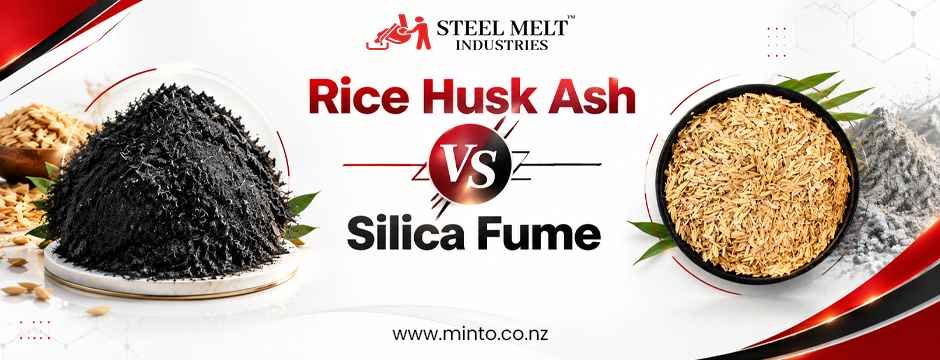
- Silica fume is generated during the production of silicon and ferrosilicon. It consists of extremely fine particles and has physical characteristics that make it valuable in applications such as cement and concrete.
- On the other hand, RHA comes from agricultural biomass and has a fundamentally different production route and morphology.
Both materials can contain significant silica, but that does not make them interchangeable. The material with the appropriate property profile should be selected for the job.
Not All Rice Husk Ash Is The Same
This is probably the most important point for anyone evaluating RHA commercially. The words “rice husk ash” do not define a uniform industrial material.
Production conditions can influence silica structure, residual carbon, particle morphology, bulk density, and thermal behaviour. Storage can also affect moisture and handling characteristics. A steel plant should therefore request a proper technical specification before approving a material.
Key parameters can include:
- Silica and overall oxide composition
- Loss on ignition
- Moisture content
- Bulk density
- Particle-size distribution
- Thermal conductivity
- High-temperature stability
- Batch-to-batch consistency
So, if you want to procure industry-grade RHA for your requirements, contact us at Steel Melt Industries.
What Steelmakers Should Ultimately Look for?
The right insulation material should answer a straightforward operational need: How can we reduce unnecessary heat loss without creating another problem?
For RHA, that means looking beyond the word “silica.”
The material needs suitable thermal resistance, controlled particle characteristics, appropriate density, low and consistent moisture, predictable chemistry, and stable high-temperature behaviour.
Final Thoughts
The usefulness of rice husk ash properties becomes clearer when the material is viewed from the steelmaker’s side of the process.
The challenge is not simply producing molten steel at high temperature. It is retaining enough thermal energy while the steel moves through ladles, tundishes, treatment stages, and casting operations.
RHA can also help by creating a porous, silica-rich insulating layer that increases resistance to heat transfer. Its physical structure can reduce conductive pathways, while the insulating cover limits direct thermal exposure of the molten surface.
FAQs
1. What makes Rice Husk Ash suitable for molten steel insulation?
Its porous structure, silica-rich composition, low bulk density, and thermal resistance help slow heat transfer from molten steel.
2. How does RHA help reduce heat loss in ladles?
The rice husk ash properties create an insulating layer over the molten surface, reducing direct exposure and slowing radiation and convection losses.
3. Is RHA suitable for tundish insulation?
Yes, properly processed RHA can effectively help maintain thermal conditions in tundishes by reducing unnecessary heat loss during casting.
4. Which Rice husk ash properties are important for steel plants?
Silica content, thermal conductivity, bulk density, particle size, moisture, porosity, and high-temperature stability are key considerations.
5. Is all Rice Husk Ash suitable for steelmaking applications?
No. Steel plants should evaluate chemical composition, processing quality, thermal performance, consistency, along with application-specific specifications before selection.