

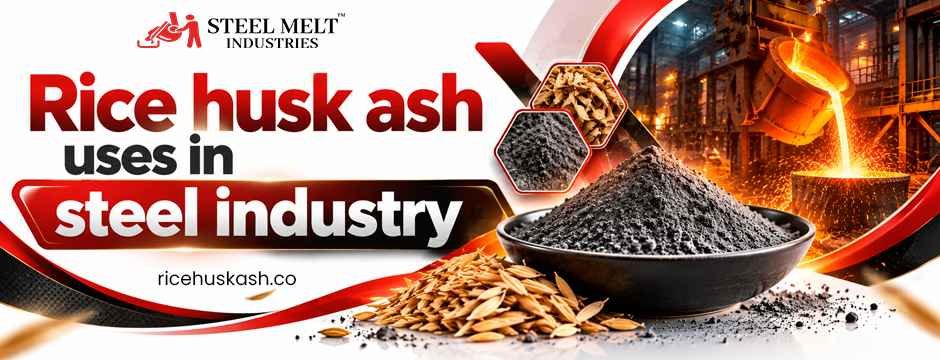
Rice Husk Ash for Ladle Insulation: How Grade, Particle Size and Application Method Affect Performance
Ladle temperature control is a critical part of steelmaking because molten steel passes through several stages between tapping, refining, holding and casting. During these stages, heat is continuously transferred from the molten steel to the ladle lining, slag layer and surrounding environment. A covering material applied over the exposed molten steel surface is one approach used to reduce heat loss from the top surface. Rice Husk Ash Uses (RHA) has been used as an insulating material in metallurgical applications, including coverings for molten metal in ladles and tundishes. Its low bulk density, porous structure and thermal characteristics make it suitable for selected insulation applications.
The thermal behaviour of a ladle is therefore influenced by the refractory system, operating time, temperature, surface condition and the measures used to limit heat loss. Research on steel ladles has shown that heat transfer occurs through several mechanisms, including conduction, convection and radiation, with the thermal history changing throughout the refining cycle.
However, selecting RHA for ladle insulation is not simply a matter of buying a material described as “high silica” or “insulating.” The grade, SiO2 content in rice husk ash, particle-size distribution, moisture, loss on ignition, bulk density and application method can all influence how the material behaves in storage, handling and application.
There is also an important metallurgical consideration. RHA contains significant silica, and research on its use as tundish insulation has demonstrated that silica from RHA can participate in slag-metal reactions under certain conditions. Therefore, thermal performance should be evaluated alongside chemistry and steel cleanliness requirements.
Why Ladle Insulation Requires More Than Refractory Lining
A steel ladle is not simply a container for molten steel. It is an integral part of the process route and can be involved in transportation, holding, refining and transfer to continuous casting.
During operation, heat can leave the molten steel through the ladle wall and through the upper surface. The ladle lining provides thermal resistance between the molten steel and steel shell, while the exposed upper surface presents another heat-transfer path.
Studies of ladle heat transfer have demonstrated that thermal behaviour is affected by the refractory lining, temperature distribution, holding conditions and heat-transfer mechanisms. One numerical and experimental study of steel ladle heat transfer found that the insulation layer produces a significant temperature drop across the insulated region, demonstrating its role in limiting heat transfer.
Top-surface covering is therefore complementary to the ladle’s refractory and insulation system. It should not be viewed as a replacement for the engineered lining.
For a steel plant, the relevant question is not simply:
“Does Rice Husk Ash provide insulation?”
The more useful question is:
“Which RHA grade, particle-size distribution and application method provide the required surface coverage and thermal behaviour without creating unacceptable process or metallurgical effects?”
That distinction is important when evaluating an RHA supplier.
How Rice Husk Ash Provides an Insulating Covering
Rice husk ash is produced through the controlled combustion of rice husk. Its properties can vary substantially depending on the combustion conditions, processing route and subsequent treatment.
The resulting ash can contain a high proportion of silica, while its physical structure can retain a porous morphology. Research into RHA-based thermal insulation has specifically linked thermal behaviour to factors such as particle size, porosity, density and microstructure.
Research has also shown that combustion conditions affect the form of silica in RHA. Under suitable combustion conditions, silica can remain predominantly amorphous, while higher temperatures can promote crystallisation into phases such as cristobalite.
This matters because “Rice Husk Ash” is not a single material with identical characteristics across all suppliers.
Two products may both be called RHA while having different:
- Silica content
- Carbon or LOI
- Particle-size distribution
- Bulk density
- Porosity
- Moisture
- Mineralogical characteristics
- Colour and physical appearance
Consequently, steel plants should evaluate the actual product specification rather than selecting a material based solely on its name.
Grade Selection: Why the RHA Specification Matters
Grade selection should start with the intended steelmaking application.
For ladle insulation, the material needs to form a stable covering over the exposed molten-steel surface while providing the required thermal resistance for the operating period.
The most relevant parameters can include:
| Parameter | Relevance to ladle application |
| SiO2 | Major chemical constituent and important specification parameter |
| LOI | Indicates material lost during ignition and can reflect residual combustible matter |
| Moisture | Important for storage, handling and safe process use |
| Particle size | Affects spreading, flow and surface coverage |
| Bulk density | Influences volume, handling and covering characteristics |
| Porosity | Related to the physical structure and thermal behaviour of the material |
| Product form | Determines handling and feeding characteristics |
| Chemical impurities | May be relevant to process chemistry and slag interactions |
| Consistency between batches | Important for repeatable plant performance |
These parameters should be assessed together.
SiO2 Content in Rice Husk Ash
The SiO2 content in rice husk ash is particularly important because silica is naturally concentrated in rice husk and remains a major component of the resulting ash.
Published research has reported RHA with very high silica concentrations, while also demonstrating that the silica structure can change with combustion conditions. A study of rice-husk-derived silica found amorphous silica at lower combustion temperatures and increasing crystalline phases at higher temperatures.
For steelmaking, however, a high SiO2 value should not automatically be interpreted as meaning that one RHA product will perform better than another.
The chemical environment of the steelmaking process matters.
This is particularly relevant where RHA comes into contact with slag associated with molten steel. Research into RHA insulation powder in continuous-casting tundishes found that increasing the RHA contribution to the covering system increased silica activity in the slag layer under the studied conditions. The researchers observed increased silicon and oxygen pickup and more reoxidation inclusions at higher RHA ratios.
Therefore, RHA chemistry should be evaluated in relation to the plant’s steel grade, slag chemistry, refining practice and cleanliness requirements.
Particle Size and Its Effect on Ladle Application
Particle size is one of the most practical considerations when selecting an RHA product.
A fine powder and a granular or pelletised material can have substantially different handling characteristics even if their basic chemical composition is similar.
Fine RHA Powder
A fine powder can be suitable where the application requires relatively fine material to be distributed over the molten steel surface.
Potential considerations include:
- Surface coverage
- Spreading behaviour
- Dust generation
- Storage and transfer
- Manual application
- Feeding equipment
- Layer uniformity
However, finer material is not automatically preferable. Very fine particles can create additional handling and dust-control considerations, particularly where the material is manually transferred or pneumatically handled.
Pelletised RHA
Pelletised RHA provides a more defined granular form.
This can be relevant where the steel plant uses equipment designed for controlled granular feeding. Particle-size consistency can also influence how material flows through hoppers, chutes and dosing systems.
Steel Melt Industries supplies RHA in both powder and pellet forms for suitable industrial applications. Our typical product information specifies a 0-1 mm grain-size range for RHA Powder and a 0-6 mm range for RHA Pellets, with at least 90% of the respective product within the stated range.
These are product-specific characteristics, not universal industry standards. A steel plant should specify the particle-size distribution required for its own equipment and application.
Powder vs Pellets for Ladle Insulation
The choice between powder and pellets should be based on the plant’s material-handling and application system.
| Consideration | RHA Powder | RHA Pellets |
| Particle form | Fine | Granular |
| Surface distribution | Suitable for fine coverage | Depends on pellet size and application |
| Dust handling | Greater consideration for fine particles | Generally easier to handle than very fine powder |
| Automatic feeding | Depends on equipment | Can be suitable for systems designed for granular materials |
| Storage | Requires moisture and dust control | Requires moisture control and appropriate bulk handling |
| Application rate | Depends on process | Depends on process |
| Selection basis | Application and feeding method | Application and feeding method |
Neither form should be treated as universally superior.
A plant with manual application may have different requirements from a plant using automated material feeding. The same plant may also require different product characteristics depending on ladle size, holding time and operating sequence.
How Application Method Affects RHA Performance
The way RHA is applied can be just as important as the specification of the material.
The objective is to establish an appropriate and sufficiently uniform insulating covering over the exposed molten steel surface.
An application system should therefore be evaluated for:
- Distribution uniformity
- Material flow
- Application rate
- Dust generation
- Coverage area
- Operator handling
- Feeding consistency
- Timing of application
- Storage-to-application losses
For manual application, operators have greater control over where material is distributed, but consistency can depend on operating practice.
For mechanical or automated application, flow characteristics become more important. Particle size, density and product form should be compatible with the feeding equipment.
This is why a supplier should understand the plant’s application method before recommending a specific RHA grade.
How Ladle Size and Holding Time Affect Material Requirements
RHA consumption should not be defined only by tonnes of steel.
The required quantity of covering material can also depend on:
- Ladle diameter
- Exposed surface area
- Steel volume
- Holding duration
- Transfer time
- Application thickness
- Product bulk density
- Application losses
- Feeding method
For example, two plants processing the same steel grade may have different RHA requirements if their ladle dimensions, holding periods or application systems differ.
This is also why a fixed “consumption per tonne of steel” should not be presented as a universal value without plant-specific operating data.
A more useful procurement approach is to establish the current consumption, surface area and application conditions, then evaluate the material under controlled plant conditions.
Moisture, LOI and Storage Conditions
Moisture should be included in the product specification when purchasing RHA for industrial use.
A material containing excessive moisture may behave differently during storage and feeding compared with a controlled, dry product. Proper packaging and storage are therefore important for maintaining product consistency.
LOI, or Loss on Ignition, should also be reviewed.
LOI represents the mass lost when a material is heated under specified test conditions. In RHA, it can provide an indication of residual combustible or volatile material, although the precise interpretation depends on the test method and composition.
Steel plants should therefore avoid using LOI as a standalone measure of product quality.
A complete evaluation should consider LOI together with:
- SiO2
- Other oxides
- Moisture
- Particle size
- Bulk density
- Product form
- Application requirements
The Metallurgical Consideration: RHA Is Not Only an Insulator
One of the most important findings from published research is that the role of RHA in molten-steel systems should not be evaluated solely from a thermal perspective.
RHA can provide insulation, but its silica-rich composition can also participate in reactions within the slag-metal environment.
A peer-reviewed study published in Metallurgical and Materials Transactions B investigated RHA insulation powder in a continuous-casting tundish. The study found that increasing the RHA proportion in the covering system increased silica activity and was associated with silicon and oxygen pickup in the molten steel, as well as an increase in reoxidation inclusions under the studied conditions. The researchers also reported an effect on MgO refractory corrosion.
Subsequent research examined calcium-aluminate flux alongside RHA and reported that increasing the calcium-aluminate contribution suppressed silicon and oxygen pickup under the experimental conditions.
A 2025 study examining tundish fluxes for Ti-containing stainless steel similarly reported that RHA-containing systems could influence inclusion behaviour and total oxygen, depending on the flux combination.
These studies were conducted under specific experimental and process conditions, so their results should not be treated as a universal prediction for every ladle or tundish operation.
They do, however, establish an important procurement principle:
Thermal insulation performance and metallurgical compatibility need to be evaluated together.
For plants producing clean steels or grades with tightly controlled chemistry, RHA selection should therefore involve both refractory/process and metallurgical teams.
Technical Specification to Request From an RHA Supplier
A steel plant evaluating a new RHA supplier should request a defined technical specification rather than relying only on a product description.
A practical procurement specification can include:
| Specification area | Parameters to define |
| Chemistry | SiO2, Al2O3, Fe2O3, CaO, MgO and other relevant oxides |
| Physical properties | Particle size, bulk density and appearance |
| Combustion-related characteristics | LOI |
| Moisture | Maximum permissible moisture |
| Product form | Powder or pellet |
| Particle distribution | Required percentage within specified size range |
| Packing | Bags, jumbo bags or other required format |
| Documentation | COA, TDS and MSDS |
| Supply | Required quantity, MOQ and monthly requirement |
| Application | Ladle covering, tundish covering or other defined use |
This creates a common technical basis for supplier comparison.
COA, TDS and Rice Husk Ash MSDS
Industrial buyers should also review product documentation before approving a new RHA source.
A Rice Husk Ash MSDS provides safety and handling information relevant to the product. The TDS provides technical characteristics and intended product specifications, while the COA can provide applicable test results for a particular batch or shipment.
These documents serve different functions:
| Document | What it helps the buyer evaluate |
| COA | Applicable chemical and physical test results |
| TDS | Product specification and technical characteristics |
| Rice Husk Ash MSDS | Handling, storage, safety and hazard information |
The documents should correspond to the actual grade being supplied.
If a steel plant has an existing RHA specification, sharing that specification with the supplier is preferable to asking for a generic “high-silica RHA.” It allows the supplier to assess the requirement against an identifiable set of technical parameters.
How to Evaluate RHA Performance at Plant Level
A new RHA product should ideally be evaluated using measurable plant parameters rather than relying on general product claims.
A steel plant can establish a controlled evaluation covering:
- Initial material specification
- Ladle size and steel quantity
- Application rate
- Application method
- Holding duration
- Steel temperature at defined process points
- Material consumption
- Surface coverage
- Dust and handling behaviour
- Slag interaction
- Relevant steel chemistry
- Inclusion or cleanliness indicators where applicable
This allows the plant to compare the new product against the existing material using its own operating conditions.
The evaluation should also distinguish between the thermal effect of the covering material and the broader thermal behaviour of the ladle. Ladle lining condition, preheating, ladle age, holding time and process route can all affect temperature loss. Research has demonstrated that ladle heat preservation is a system-level issue rather than a function of one material alone.
Rice Husk Ash Uses in Steel Industry
The broader Rice husk ash uses in steel industry include applications where a silica-rich, lightweight and thermally insulating material is suitable for the process.
These can include:
- Ladle covering and insulation
- Tundish covering and insulation
- Selected refractory applications
- High-temperature insulation applications
- Other steelmaking processes where the product specification is compatible
The suitability of RHA varies by application.
Ladle and tundish operations should not automatically be treated as identical because the material can interact differently with the slag and molten-steel environment. Published studies on tundish applications demonstrate why the chemical characteristics of an insulation material need to be considered alongside its thermal function.
For this reason, an RHA specification developed for one steelmaking application may not automatically be suitable for another.
Why Steel Melt Industries for Rice Husk Ash
At Steel Melt Industries, we manufacture and supply Rice Husk Ash and related rice husk-based materials for suitable steelmaking and foundry applications. Our range includes RHA Powder and RHA Pellets with defined product characteristics for industrial buyers evaluating ladle and tundish insulation requirements. We can discuss requirements such as SiO2 content, particle size, moisture, LOI, product form, packing and quantity before supply. Our typical RHA product information includes a SiO2 specification of approximately 85-90% or higher, with product-specific limits for other oxides, LOI, moisture and particle size. We can also provide applicable COA, TDS and Rice Husk Ash MSDS documentation to support technical and procurement evaluation. For bulk and export requirements, our team can discuss product specifications, packing, shipment quantity and destination requirements with industrial buyers.
Conclusion
Rice Husk Ash can be a useful insulating covering material for suitable ladle applications, but its performance should be evaluated as part of the complete steelmaking process.
The most important consideration is not simply whether an RHA product contains a high percentage of silica. Grade, SiO2 content, particle-size distribution, moisture, LOI, bulk density, product form and application method all influence how the material behaves during handling and use.
Particle size is particularly relevant when deciding between powder and pelletised RHA. Fine powder may provide the characteristics required for particular surface-covering applications, while pelletised material can provide different flow and feeding characteristics for suitable equipment.
Chemistry also requires careful consideration. Published research demonstrates that silica from RHA can participate in slag-metal reactions under specific tundish conditions, meaning that thermal insulation requirements should be considered alongside steel chemistry, slag practice and cleanliness objectives.
For procurement teams, the most reliable approach is therefore to define the required specification before comparing suppliers. A clear requirement covering chemistry, particle size, moisture, LOI, product form, packing, documentation and application conditions provides a stronger basis for technical evaluation and bulk purchasing.
Frequently Asked Questions
What is Rice Husk Ash used for in ladle insulation?
Rice Husk Ash can be applied as a covering over exposed molten steel in suitable ladle applications. Its porous, lightweight structure and thermal characteristics allow it to function as an insulating covering material. The suitability and required application rate depend on the ladle, steelmaking process and RHA specification.
Does higher SiO2 content always mean better RHA for steelmaking?
No. SiO2 is an important RHA specification, but it should not be considered in isolation. The complete chemistry, particle size, LOI, moisture, physical characteristics and intended steelmaking application should be evaluated together. Research also shows that RHA-derived silica can participate in slag-metal reactions under specific conditions.
What is the difference between RHA Powder and RHA Pellets?
RHA Powder is a fine material, while RHA Pellets are supplied in a defined granular form. The appropriate form depends on the application, required coverage, handling method and feeding equipment. Steel Melt Industries supplies both forms for suitable industrial applications.
Why is particle size important when selecting Rice Husk Ash?
Particle size affects material flow, handling, spreading and surface coverage. It can also influence compatibility with automated feeding systems. Therefore, buyers should specify the required particle-size distribution rather than relying only on a general product description.
What documents should a steel plant request from an RHA supplier?
A steel plant can request the applicable Certificate of Analysis (COA), Technical Data Specification (TDS) and Rice Husk Ash MSDS. These documents provide different information covering product characteristics, applicable test results and safety or handling requirements.
Can Rice Husk Ash affect molten-steel chemistry?
RHA contains significant silica, so interactions with slag and molten steel need to be considered. Research in continuous-casting tundish conditions has reported silicon and oxygen pickup and increased reoxidation inclusions under particular RHA-to-slag conditions. The findings are process-specific and should not be assumed to apply identically to every steelmaking operation.